The flu pandemic
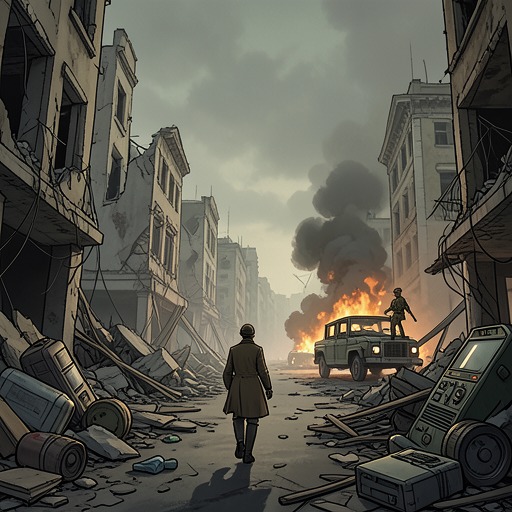
The Dog StarsThe flu pandemic is the cataclysm behind the novel’s emptied world, killing nearly everyone and leaving survivors to face a second disease, failed institutions, and a landscape altered by ecological loss. Recounted by Hig nine years after the outbreak, it is less a single bounded crisis than the dividing line between the old world and a precarious present whose damage continues to unfold.
Outbreak and Human Toll
Hig describes the flu as having killed almost everybody. He places his own severe illness within that history: he remembers two straight weeks of fever, including three days at 104 to 105 degrees, and wonders whether it affected his mind. His account conveys survival without claiming full recovery; under stress, his thoughts can feel dislocated and difficult to trust.
The flu was followed by a blood disease that killed more people. Among the survivors Hig knows are about thirty members of a Mennonite community ten miles south of his airport. He understands the disease as a slow-burning plague, though he can only compare it tentatively to AIDS and is unsure how contagious it is. Children are born with it, remain sick and weak, and some die each year. The continuing losses make clear that the pandemic’s aftermath is not a clean return to life for those who escaped the initial outbreak.
Collapse of Care and Communication
The failure of medical care appears in Hig’s recollection of St. Vincent’s Hospital across the lake. Orange helicopters had landed there, but as conditions worsened, Hig and Melissa went to a building taken over by the hospital that was filling with the dead. The institution remained a destination, yet could no longer offer a way out of the crisis.
Cima’s memories of the final period show how public communication dwindled alongside medical capacity. Television anchors and field correspondents grew exhausted, then frightened, as colleagues disappeared into hospitals and makeshift flu wards or were no longer heard from. The reports became more frantic before they were cut off by mayhem. The broadcasts persisted for a time as evidence of an effort to keep informing people, even as the systems around them failed.
Flight, Violence, and Survival
As the crisis intensified, Pops and Cima left their ranch at night with livestock, horses, dogs, and supplies. In the fifteen miles toward the creek road, Pops encountered three barricaded ambushes; farther on, he killed three attackers in the cedar hills. One horse and two sheep were shot during the escape. The losses made it harder to disguise their departure as an ordinary seasonal move. Once they reached the canyon, Pops and Cima returned downstream and used dynamite to destroy the ford, making the route impassable to vehicles.
The departure shows how the breakdown of ordinary life turned movement into a dangerous undertaking and self-protection into a necessity. It also records a different kind of response from Hig’s airport partnership with Bangley: rather than defend a fixed perimeter, Pops and Cima carried people and animals away from an exposed home and made their route harder to follow. Their choices belong to the same unsettled aftermath, in which safety depends on local judgment rather than dependable public protection.
Ecological Aftermath and the Long Present
The pandemic’s human toll is set beside losses whose causes are not simply attributed to the flu. Hig mourns the disappearance of every trout he once fished for, and recalls other vanished animals, including tigers, elephants, and several kinds of bird and whale. He connects the loss of trout to streams growing too warm. By mid-April, seasonal expectations have weakened: mountain snow is less reliable, and for two successive years the peaks had held almost none. The prospect of losing the creeks frightens him even more than attacks or disease.
Fishing makes this ecological change personal and specific. Hig still visits mountain streams, but fishes for suckers and carp where trout once lived, learning to eat fish he once disliked. Later he catches five carp and recognizes that they, too, are starving; he releases them carefully and stops fishing. The change is not presented as a recovery of what vanished. It is a small act of care within a diminished environment, where even the species that filled the trout’s former niche are vulnerable.
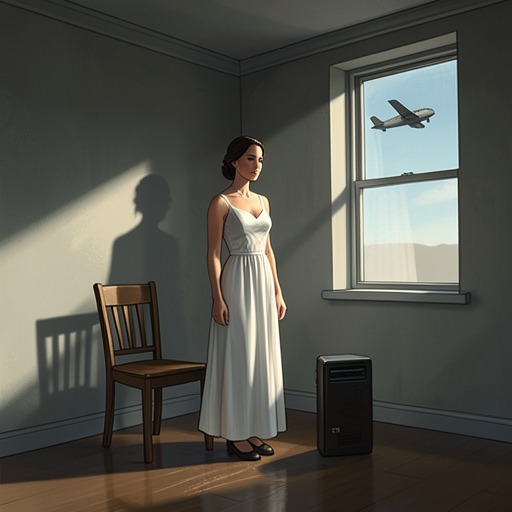
Hig’s memories of surviving places preserve another measure of what has been lost. In a stretch of forest that has not died or is beginning to return, he sets down his pack, kayak sled, and rifle, assembles the four pieces of the Sage pack rod his father gave him at sixteen, and listens to the creek. Such moments do not undo the pandemic or environmental decline; they show what remains valuable to him amid them. Years later, he hears two 747s pass overhead and calls repeatedly over the radio, but receives no reply. The planes establish that aircraft still cross the sky, not that the old social world has returned. The pandemic’s defining consequence is this unresolved distance between signs of life and the possibility of connection.